You sprained your ankle two weeks ago, two months ago, maybe four months ago. The swelling is gone, but it still hurts when you lean on that leg, and you can't play basketball or hockey, or simply go for a long walk with your kids. People often come to our Mississauga clinic three, four or five months after the injury, and they all ask the same thing: why isn't it healing? We work alongside your family doctor and physiotherapist.
Video: why your ankle sprain hasn't healed
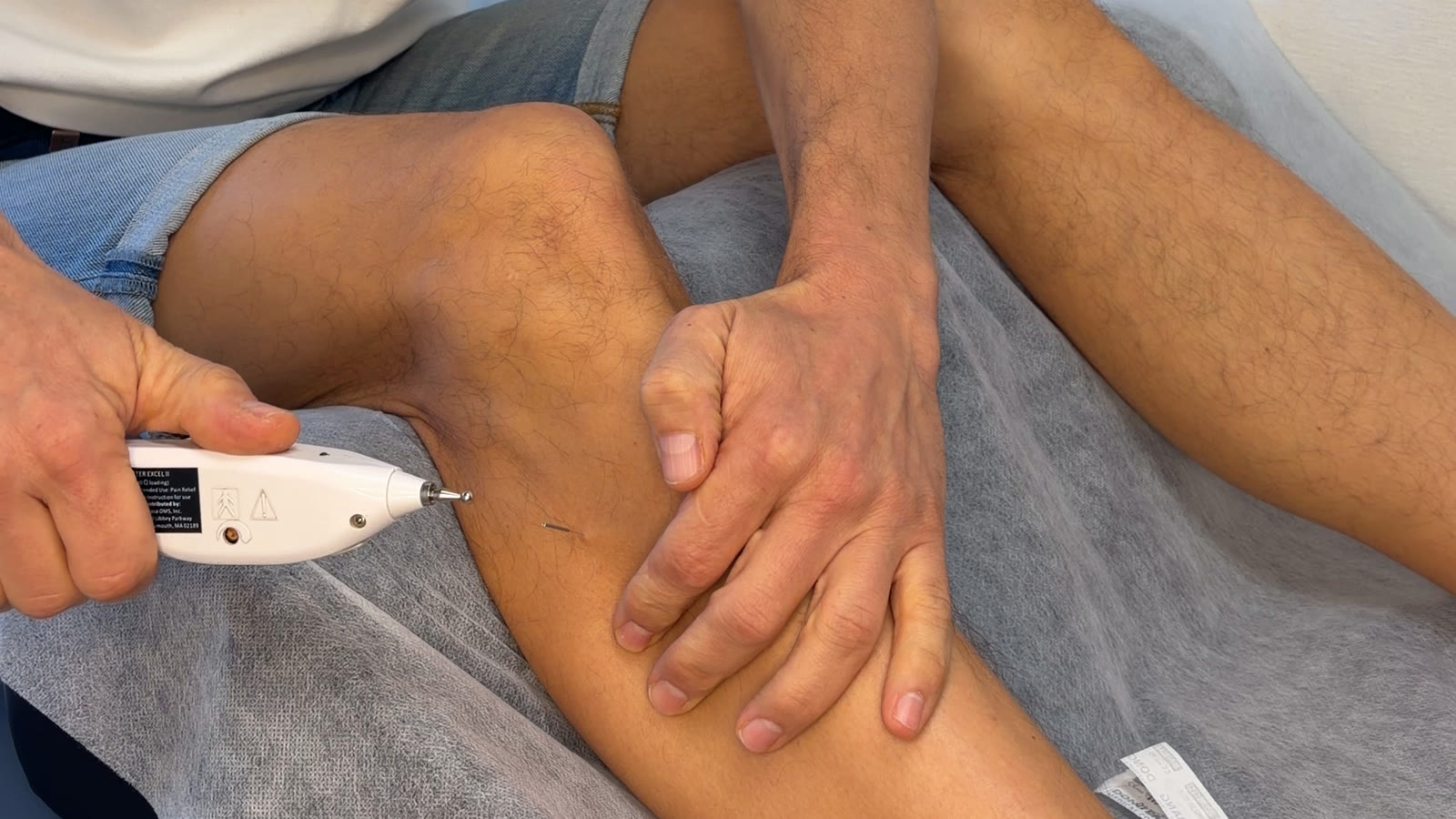
In this video Dalibor explains which two muscles stop working after a sprain, shows on his own leg where he works on them, and explains why we never put needles into the sore spot.
Why does an ankle sprain still hurt months later?
A sprain is an injury to the ligaments of the ankle. Most sprains heal in about two to four weeks. When one doesn't, the reason is often not the ligament itself but two muscles in the lower leg that nobody worked on after the injury:
- Peroneus longus runs down the outside of the lower leg. It supports the ankle from the side and stops it rolling outwards.
- Tibialis posterior is a deep muscle at the back and inside of the lower leg. It supports the ankle and the arch from the inside.
After a sprain, these two muscles are often inhibited: they don't contract on time. So every time you step, they don't absorb the weight of your body, and the whole load goes into the ankle joint that is already injured. Without getting these muscles working again, you keep re-injuring the ankle a little with every step. The job of a muscle isn't only to move you. It's to protect your joints.
The body adds a second problem. When the brain senses that part of the body is injured, it tightens the muscles around it to protect it. Tight muscles squeeze the small blood vessels, less blood reaches the area, and the ligaments get less oxygen and fewer nutrients to repair themselves. That is how a simple sprain turns into a chronic injury. Ice and arnica can help early on, but they don't change how these muscles work.
How do you treat a sprained ankle that won't heal?
- Motor point work on the two muscles. A motor point is the spot where the nerve enters the muscle. Dalibor stimulates the motor points of peroneus longus and tibialis posterior so the muscles start firing again. You can see the foot move to the side, then inwards, as each muscle contracts. When they work properly, they take load off the joint every time you step.
- No needles in the sore spot. The injured area is often swollen, so we work indirectly, on the muscles of the lower leg and on points away from the injury.
- Points that improve blood flow to the ankle. Blood carries the oxygen and nutrients the ligaments need to heal.
- Hips and knees too. If you have limped for a couple of months, the hip and knee muscles often start compensating. If we don't work on those as well, you keep a weak spot. Our page on knee and hip pain explains how we look at them.
Some people also benefit from mild electrical stimulation on pairs of needles. Our article on electro-acupuncture explains how it works.
What can I do at home?
You can gently massage the area over the two muscles: the outside of the lower leg below the knee (peroneus longus) and the inside of the lower leg along the shin bone (tibialis posterior). It's a start. Acupuncture on the motor points goes further, because it works directly where the nerve enters the muscle. If a physiotherapist has given you balance and strength exercises, keep doing them.
What happens at the first visit?
Before any treatment, we sit down and Dalibor asks how and when you injured the ankle, how long it has been a problem, what you have already tried, and what you want to get back to: running, a sport, or just walking without thinking about it. He then examines the ankle and checks the muscles of the lower leg, knee and hip, to see what is working and what isn't. If anything points to a fracture or a torn ligament that needs imaging first, we will tell you.
Acupuncture, physiotherapy or chiropractic?
Physiotherapy builds strength, balance and movement. Chiropractic focuses on joints. Acupuncture works on getting the stabilising muscles to fire on time and on blood flow to the injured area. They work well together, and many of our patients see a physiotherapist as well.
When should I see a doctor instead?
See a doctor or go to urgent care if you couldn't put weight on the foot right after the injury, if the ankle bone or the bone on the outside of the foot is tender to touch, if the foot is numb, cold or pale, or if the ankle looks deformed. These can be signs of a fracture. Once a fracture is ruled out, acupuncture can fit alongside your medical care.
Is it safe?
Acupuncture with sterile single-use needles is generally low-risk when performed by a registered practitioner. Some people notice minor bruising or brief soreness at a needle site. Please tell us about any medications, especially blood thinners, and whether you are or might be pregnant.
Visiting our Mississauga clinic
- Where: Unit 229, 1550 Enterprise Road, Mississauga, near Hwy 401 & Dixie Rd. Free parking at the building.
- Hours: Tuesday and Friday 9 to 2, Wednesday and Thursday 2 to 6, Saturday 9 to 2.
- Who comes: people who play basketball, hockey, soccer or run, and people who simply want to walk without pain, from across Mississauga, Etobicoke, Oakville and the rest of the GTA.
- Car accidents and work injuries: we don't treat car accident or WSIB work-injury claims, and we don't bill auto insurance or WSIB.
- What to wear: shorts or loose trousers that roll up above the knee.
What does it cost, and is it covered?
Your first visit is $230: an initial examination ($110) and your first acupuncture treatment ($120), about 1 hour 15 minutes in total. After that, Dalibor puts together a care plan with you, so you know the number of visits and the cost before you commit. Follow-up treatments are $120. Many extended health plans cover acupuncture by a Registered TCM Practitioner; check your plan for limits. Full details are on our fees and insurance page.
When you are ready, you can book a first visit online or call 647-342-2281. For a longer explanation in Dalibor's own words, read why a sprained ankle still hurts months later.
For an overview of how we treat all kinds of pain, see acupuncture for pain relief in Mississauga.
Common questions about ankle sprains and acupuncture
How long should a sprained ankle take to heal?
Most ankle sprains heal in about two to four weeks. If yours still hurts after a month or two, or keeps giving way, it is worth having it checked. Often the muscles that protect the ankle are not working properly yet.
Does acupuncture help an ankle sprain?
Research on acupuncture for ankle sprains is limited and the results are mixed, so we can't promise an outcome. What we do is practical: we work on the motor points of the two muscles that stabilise the ankle, and on points that bring more blood flow to the area. Results vary from person to person.
My ankle is still swollen. Can I come in?
Yes. We don't put needles into the swollen or painful spot. We work on the muscles of the lower leg and on points away from the injury.
Do I still need physiotherapy?
Acupuncture fits well alongside physiotherapy. Physio builds strength and balance; we work on getting the muscles to fire on time again. If you have exercises from your physiotherapist, keep doing them.
Do I need an X-ray first?
See a doctor first if you couldn't put weight on the foot right after the injury, if the bone itself is tender, if the foot is numb, or if the ankle looks deformed. A fracture needs medical care before acupuncture.
This page is general information, not medical advice. Acupuncture works alongside the care you get from your family doctor. If your symptoms are new, severe or getting worse, see your doctor first.