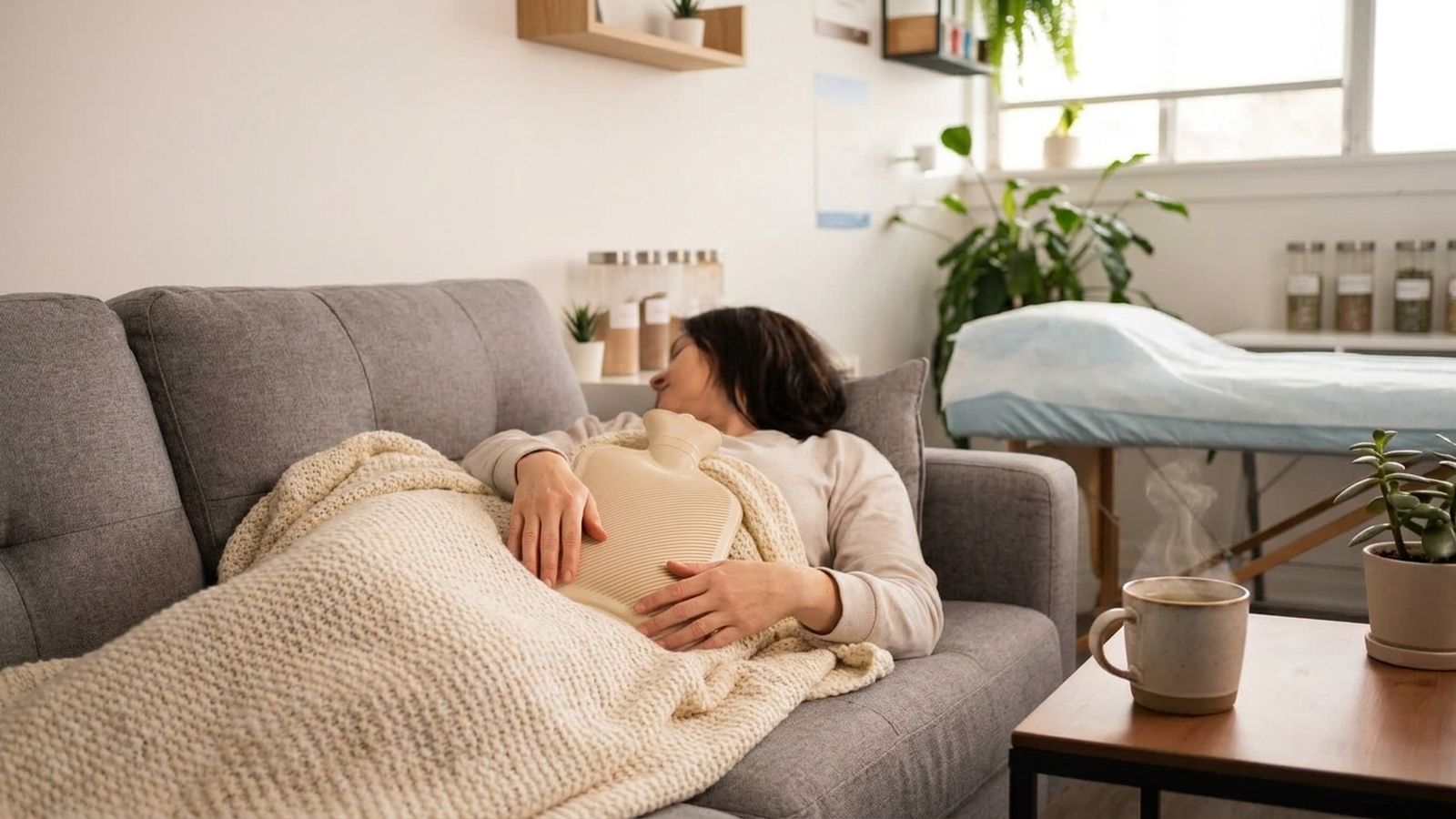
Period pain is common, but you don't have to just put up with it. People come to us because cramps keep them home from work or school, because PMS affects their mood and sleep, or because their cycle has changed and they want to understand why.
Watch: what a healthy period looks like
If you're taking painkillers every single month for your period, then this video is for you. Stats in Canada show that 60% of women describe moderate or severe pain, and 17% of them have to skip school or miss a day of work because of painful periods.
Your period should be regular. What does that mean? Somebody has a period every 28 days, it might be 26 days, it might be up to 30 days, but regular means it comes every month like clockwork. So regularity is first. It should not be painful. The blood should be bright red, just like when you cut yourself, and there should be no blood clots.
Most of the time, clots point to blood stagnation in the uterus. In Chinese medicine we call that a cold uterus. And your grandma knew it: one of the channels, the kidney channel, starts at the feet, goes up and passes through the uterus. Your grandma was right. Don't walk barefoot on the tiles, and don't expose this part of your body when it's cold.
So remember, a period shouldn't be painful. You should be able to do everything on those few days of the month. You should be able to live your life.
What happens at the first visit?
Your first visit is an initial examination ($110, about 60 minutes) followed by your first acupuncture treatment ($120), about 1 hour 15 minutes in total. We'll ask about your cycle in detail: length, flow, pain, PMS and how it has changed over time, plus sleep, digestion, stress and health history. A cycle-tracking app or notes from the last few months are very helpful if you have them. Then comes a TCM assessment, including pulse diagnosis, and your first treatment.
At the end we suggest a plan and explain costs before you commit. Your first visit is $230 in total, and follow-up treatments are $120. A period pain plan usually runs three months, once a week, so Dalibor sets it up as a care plan with payment options. If you live far away, we can work with herbs only, and then we usually see you about once a month. Insurance details are on our fees and insurance page. We're open Tuesday and Friday 9 to 2, Wednesday and Thursday 2 to 6, and Saturday 9 to 2. We don't have evening hours. The clinic is at Unit 229, 1550 Enterprise Road in Mississauga, near Hwy 401 and Dixie Road, with free parking, about 20 minutes from Etobicoke. Book your first visit online or call 647-342-2281.
What happens during a treatment?
You lie face up on the table. For period pain I use points below the knees and below the elbows, so wear loose clothes that roll up easily. I don't use points on the belly or the low back. You're welcome to bring a friend, your partner or your mum into the room with you. We only ask for quiet: there's no talking in the healing room, so you can rest.
Planning a pregnancy? Regular, pain-free cycles matter when you're trying to conceive. See our page on fertility acupuncture. We also keep seeing women once they're pregnant.
What do people come in for?
- Period pain (dysmenorrhea): cramping in the lower belly, sometimes spreading to the low back or thighs.
- PMS: irritability, low mood, anxiety, breast tenderness, bloating, headaches or food cravings in the days before a period.
- Cycle symptoms: heavy or very light flow, clots, spotting, or a cycle that's shorter, longer or less regular than it used to be.
- Related complaints: fatigue, poor sleep, digestive upset or headaches that follow the cycle.
If you have a diagnosis such as endometriosis or polycystic ovary syndrome (PCOS), we work alongside your gynecologist and family doctor. Acupuncture doesn't replace their care, and we'll encourage you to keep your medical follow-ups.
How common is period pain?
More common than most people think. In a Canadian survey of more than 1,500 women who menstruate, 60% had period pain (the medical term is primary dysmenorrhea). Of those, 60% described the pain as moderate or severe. About half said it limited their usual activities, and 17% had missed work or school because of it.1 Canada's obstetricians and gynaecologists describe period pain as "common and frequently undertreated".2
Sources: 1. Burnett MA et al., "Prevalence of Primary Dysmenorrhea in Canada", J Obstet Gynaecol Can, 2005. 2. SOGC Clinical Practice Guideline No. 345, 2017.
When should I see a doctor first?
How does Chinese medicine look at period pain?
Traditional Chinese Medicine (TCM) treats the cycle as a sign of overall health. Each phase depends on good blood flow. Period pain is often described as stagnation, meaning blood isn't moving smoothly through the uterus; clots are one of its common signs. Cramps that ease with heat may point to a cold pattern. PMS with irritability and breast tenderness is often linked to an inflamed liver, which is closely tied to stress. Tiredness, a light flow and a dull ache may suggest a Blood deficiency pattern, where the body is run down.
These are TCM patterns, not medical diagnoses. They help Dalibor plan treatment around you rather than around one symptom. Two people with period pain may get quite different plans.
How does acupuncture for period pain work in practice?
We use acupuncture to encourage blood flow to the pelvic area. The aim is better circulation, so the uterine muscle can relax and cramp less.
Your plan may include Chinese herbs traditionally used to move blood and ease clotting. Alongside that, we look at your nutrition to see which foods may be contributing.
A course of treatment runs for three months. We like to start at the end of your period. Some patients notice a change by their first cycle; we usually judge progress over three cycles.
What helps period cramps besides painkillers?
If you'd rather not rely on painkillers every month, these drug-free options are worth trying at home, between visits or before you ever book. In the clinic in Mississauga, I add acupuncture and, when it fits, Chinese herbs.
- Track your cycle. Note pain, mood, flow and energy each day. Patterns become much clearer after two or three months.
- Keep warm. Many people find a heat pack on the lower belly helps with cramps. From a TCM view, a lot of cold drinks and raw food around your period may not help.
- Move gently. Walking and light stretching often feel better than staying still.
- Look after sleep and stress, especially in the week before your period. Our page on acupuncture for stress and anxiety covers this.
- Notice your gut. Bloating and bowel changes around periods are common. See our bloating and digestion page.
Your period pain questions, answered by Dalibor
These are the questions women ask me most often, in the clinic and before they ever book. The answers come from my 10 years of practice as a Registered TCM Practitioner in Mississauga.
Why are my period cramps so bad this month?
Cramps can change a lot from one month to the next. Stress, poor sleep, travel, illness, cold weather or a change in diet can all slow blood circulation in the pelvis, and when blood doesn't flow freely through the uterus, it cramps harder. One rough month is common. If the pain is sudden, severe or very different from your usual pattern, see your doctor first.
Why are my period cramps getting worse as I get older?
Period pain that keeps getting worse over the years is something I always take seriously. It can be a sign of endometriosis, adenomyosis or fibroids, so please get checked by your doctor or gynecologist. Acupuncture and herbs can sit alongside that care, aiming to improve blood circulation in the pelvis, but they shouldn't replace a proper diagnosis.
What can I do for period cramps besides painkillers?
Heat on the lower belly, gentle movement, good sleep and warm, cooked meals in the week before your period all support blood circulation to the uterus. In the clinic, I use acupuncture and, when it fits, a custom herbal formula to get the blood moving and relax the cramping. I usually recommend regular treatment over two or three cycles, not only on painful days.
Can I keep taking my usual pain medication while having acupuncture?
Yes. Acupuncture doesn't interfere with over-the-counter pain relievers, so keep using what works for you. Some of my patients find they reach for medication less often over time, but that's your decision to make with your doctor. Just let me know what you're taking, especially if we add herbs.
Can stress make period pain worse?
Yes, and it's one of the most common patterns I see. Stress tightens the muscles and constricts blood vessels, so less blood flows freely through the pelvis, and the uterus cramps harder. Acupuncture aims to calm the nervous system and help the blood vessels relax, which is why I pay close attention to stress when treating period pain.
Can food make period cramps worse? What should I avoid around my period?
It can. Sugar, refined carbs, cold foods, alcohol and processed seed oils can add to inflammation, and in my practice many women notice their cramps are worse when they eat a lot of them. I also tell patients to avoid iced drinks and lots of cold, raw food around their period, because cold slows blood circulation in the pelvis. Real, whole foods with good-quality protein and healthy fats, eaten warm, are a good base.
Why does heat help period cramps?
In Chinese medicine, cold makes blood vessels contract, and blood flow becomes slow and sticky, which causes cramping and clots. Heat does the opposite: it opens the vessels, relaxes the muscles and gets blood circulating through the uterus again. If a hot water bottle is what helps you most, that tells me a lot, and it helps me choose the right herbal prescription.
Why do I get back pain or leg pain with my period?
The uterus shares nerve pathways with the lower back, hips and thighs, so cramping pain often spreads there. In Chinese medicine, we also see this as poor blood circulation through the lower back and legs during the period. Acupuncture can treat these areas directly as part of the session.
Why do I get nausea, diarrhea or bloating during my period?
The same chemicals that make the uterus contract, called prostaglandins, also affect your bowels, which is why your digestion gets upset. In Chinese medicine, we see this as weak digestion that is easily disturbed when blood circulation shifts toward the uterus. When these symptoms come with the cramps, supporting digestion through diet, acupuncture and sometimes herbs becomes part of the plan.
Can acupuncture help heavy periods or clots?
It's a common reason women come to see me. In Chinese medicine, clots are a clear sign of poor blood circulation in the uterus, and I've worked with many women with heavy flow and clots over the years, using acupuncture and herbs. Heavy periods can also cause low iron or signal fibroids or hormonal issues, so I always recommend a check-up and blood work with your doctor as well.
Can acupuncture help PMS, like mood swings and irritability?
PMS is one of the most common reasons women come to see me. Tension and stress restrict blood circulation, which shows up as irritability, breast tenderness, headaches and bloating the week before your period. Acupuncture aims to relax the nervous system and improve circulation, and my patients often tell me they feel calmer and more even after a few cycles.
Can Chinese herbs help period pain? What are they like to take?
Herbs are one of the main tools I use for period pain, and I always make a custom formula based on your specific pattern, whether that's cold, stress, or weak or sluggish blood circulation. Most of my patients take them as granules dissolved in warm water. The taste is earthy and sometimes a little bitter, but most people get used to it quickly. Please tell me about any medications you take, and whether you're pregnant or trying to conceive.
Does acupuncture hurt? I'm nervous about needles.
I hear this every week, and I understand. Acupuncture needles are very fine, much thinner than the needles used for injections or blood tests. Most people feel a tiny pinch or nothing at all, then a dull, heavy or warm feeling. Many of my most nervous patients fall asleep on the table. We always go at your pace.
Is acupuncture safe for teenagers with period pain? From what age?
When done by a registered practitioner, acupuncture is gentle and generally low-risk for teens. I see teenagers once their periods have started, usually with a parent present for younger patients. For first-timers, I use fewer needles and gentler techniques.
How is acupuncture different from a TENS machine or period patches?
A TENS machine or heat patch eases pain while you're using it, which is useful on a bad day. Acupuncture and herbs aim at what's behind the pain: poor blood circulation in the pelvis, tension or cold. The aim is for the pain to become less intense from one cycle to the next. Many of my patients use both, a patch for comfort in the moment and treatment for the longer term.
Is acupuncture safe?
Acupuncture with sterile, single-use needles is generally low-risk when done by a registered practitioner. Mild soreness or small bruises can happen. Tell us if you are or could be pregnant, or take blood thinners. Dalibor Covic is a Registered TCM Practitioner (R.TCMP), CTCMPAO #5076.
If you'd like to see whether this approach suits you, book your first visit or call 647-342-2281 with questions.
Independent information: Cochrane review: acupuncture for period pain.
Common questions about period pain and acupuncture
Can acupuncture help with period pain?
Many people come to us for exactly this. Acupuncture is used to ease cramping and the tension around it, and Chinese medicine looks at the pattern behind your pain across the whole cycle, so treatment isn't only about the worst day. Responses vary from person to person.
What can help period cramps besides painkillers, near Mississauga?
Heat on the lower belly, gentle movement such as walking, good sleep, and warm, cooked meals in the week before your period. At our clinic near Hwy 401 and Dixie, Dalibor adds acupuncture and, when it fits, Chinese herbs, usually over two or three cycles. If your pain is new or getting worse, see your doctor first.
How many treatments will I need for period pain?
A course of treatment usually runs for three months, often once a week. Because your cycle repeats every month, it takes a few cycles to judge how things are changing. Some patients notice a change by their first cycle. Dalibor gives you a plan at your first visit and reviews it with you as you go.
When in my cycle should I come in?
We like to start at the end of your period. After that, treatments are usually once a week through the three-month course. We'll plan the timing with you.
Can I have acupuncture during my period?
Yes. Some people prefer to come during their period because that's when symptoms are strongest. Just let us know on the day.
Are bad period cramps normal?
Some cramping is common. Pain that makes you miss work or school, keeps getting worse, or comes with very heavy bleeding is worth checking with your doctor, and we're happy to work alongside them.
How common are painful periods in Canada?
Very common. A Canadian survey of more than 1,500 women who menstruate found 60% had period pain, 60% of them moderate or severe, and 17% had missed work or school because of it (Burnett et al., J Obstet Gynaecol Can, 2005). Canada's obstetricians and gynaecologists call it common and frequently undertreated.
I have endometriosis or PCOS. Can I still come?
Yes. If you have a diagnosis, we work alongside your family doctor and gynecologist, not instead of them. Keep your medical follow-ups and any treatment they've prescribed, and bring us a list of what you take.
Can I use my insurance?
Many extended health plans cover acupuncture by a Registered TCM Practitioner. Check your plan's details. Our fees and insurance information are on the fees page.
I live in Toronto or Brampton. Is the trip worth it?
The clinic is near Hwy 401 and Dixie Road with free parking, so it's easy to reach from Toronto, Etobicoke, Brampton and Oakville.
This page is general information, not medical advice. Acupuncture works alongside the care you get from your family doctor. If your symptoms are new, severe or getting worse, see your doctor first.