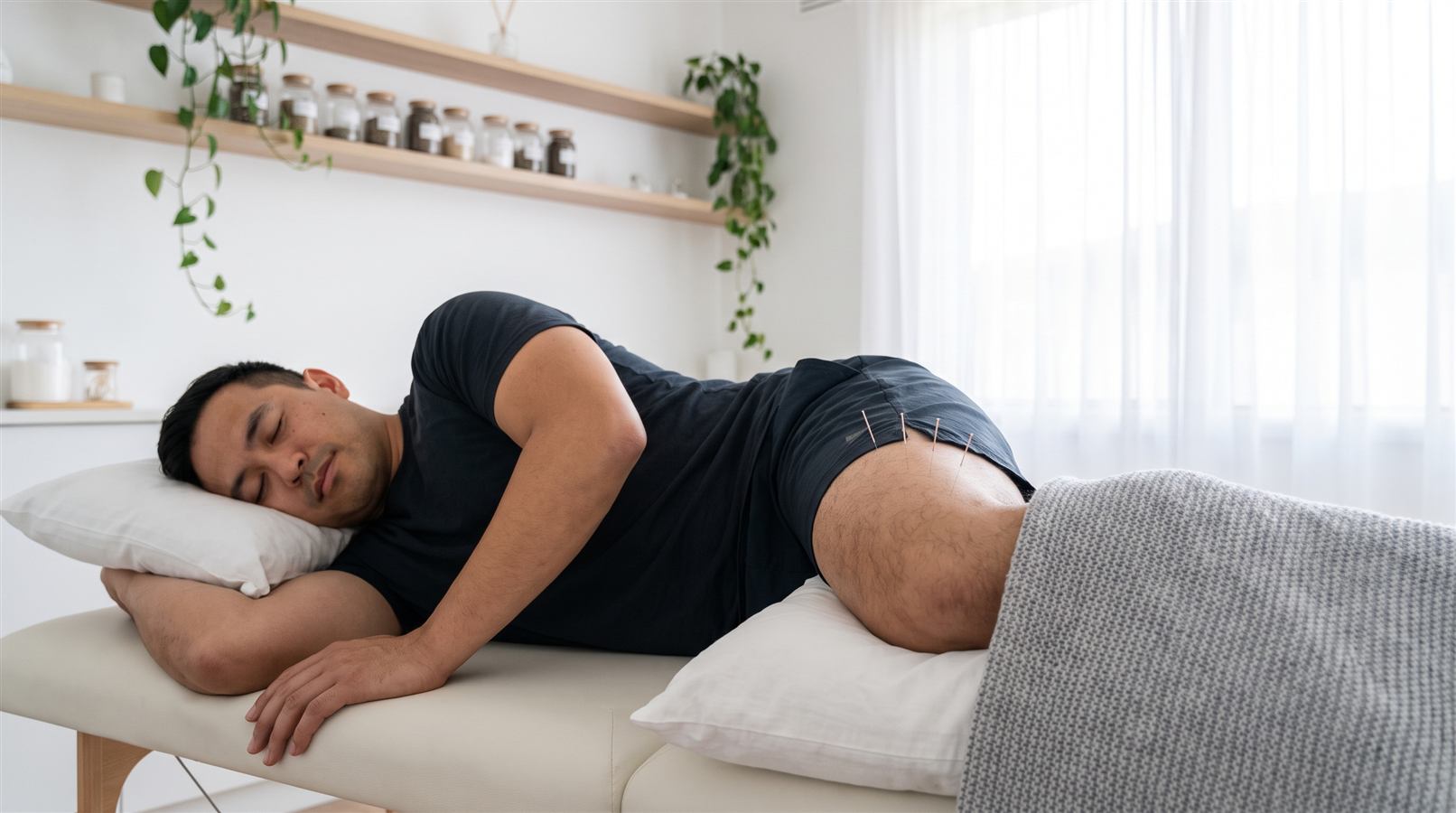
Sciatica usually means one leg: a burning, shooting or electric pain from the buttock down the back of the thigh, sometimes into the calf or foot, with tingling or numbness. It can make a walk or a long drive feel like an endurance sport. People often call us after weeks of pain that hasn't settled.
What is sciatica?
The sciatic nerve is the largest nerve in the body. It forms from nerve roots in the lower back and runs through the buttock and down the back of each leg. "Sciatica" describes pain along that path, usually because a nerve root is irritated or pressed. Common causes include a disc bulge or herniation, narrowing of the spinal canal (stenosis), or tight muscles deep in the buttock, sometimes called piriformis syndrome.
Sciatica is different from general low back pain, although the two often show up together. With sciatica, the leg pain is often worse than the back pain. Many cases settle over weeks to months with conservative care, but it can be very painful while it lasts.
What do people with sciatica tell us?
In the clinic, the problems we hear about most are walking, driving and sleeping. Walking hurts. Sleep is hard because people can't find a comfortable position, and many feel more pain when they rest. Sitting comes up less often than you might expect.
How does Chinese medicine look at sciatica?
In Traditional Chinese Medicine (TCM), sharp pain that stays in one place is described as stagnation: blood isn't flowing freely along the pathways that run down the back and side of the leg, so the tight, irritated tissue can't get what it needs to settle. Cold and damp can play a part when pain is worse in cold weather or first thing in the morning. When sciatica keeps coming back, TCM also looks at underlying weakness, often linked to the Kidneys and the lower back.
These are TCM ideas, not Western diagnoses. They help Dalibor choose points, decide whether heat or electro-acupuncture fits, and suggest what to do at home.
How does acupuncture for sciatica work?
Acupuncture uses fine, sterile, single-use needles. How we treat depends on what we find at the initial exam. Very often Dalibor uses distal needling: needles placed away from the pain, on the legs, forearms and hands. Depending on the exam, he may also use local points around the low back and buttock, and gentle electrical stimulation through the needles, called electro-acupuncture, or heat.
In Dalibor's words: "This is how we stimulate blood circulation into the painful area. More blood flow means more oxygen and nutrients reach the site, which aims to calm inflammation and the irritation around the sciatic nerve. People usually feel it as a release."
The aim is to ease pain, relax tight muscles and help you move more comfortably, so that walking, stretching and any exercises from your physiotherapist feel more manageable.
Research on acupuncture for sciatica is growing. In a 2024 trial published in JAMA Internal Medicine, 216 people with long-term sciatica from a herniated disc had either real or sham (placebo) acupuncture. Leg pain eased more in the real acupuncture group after four weeks, and the difference was still there a year later. The authors concluded that acupuncture may be worth considering for this kind of sciatica. Not every study agrees, and one trial can't predict how you will respond: some people notice changes within a few sessions, others more slowly, and some not at all. That's why we start with three treatments within a week and tell you honestly what we see, as explained in is acupuncture right for my pain?
If your symptoms are more like constant burning, numbness or pins and needles in the feet, that can be a different problem. Our article on peripheral neuropathy covers it.
How quickly will I notice a change?
It depends on how much structural damage there is and how long you've had the pain. Some people feel a change right away; for others it takes a few treatments. That's why we start with three treatments within 7 days. In that week we look for changes you can measure in daily life, such as how far you can walk or how well you sleep.
One patient's story
One of our patients, a contractor working as a framer, came in with pain shooting down the back of his leg that had lasted a month. He worked about 10 hours a day of heavy manual labour. The pain made walking hard and ruined his sleep, so he was exhausted at work, and he had to cut down his hours, which hurt his income. He was frustrated.
After the assessment we started treatment, using local and distal points on his calves, ankles, forearms and upper arms. We also worked on his core muscles, because when people have this kind of pain, the core muscles often stop working properly, and they need to work well again to support the back. After three treatments he noticed a significant improvement. We saw him three times a week for a month, 12 treatments in total. By then he could do a full day's work and was sleeping much better. We continued twice a week, and instead of pain he now felt only some stiffness.
That is one person's experience, and every body responds differently. It shows how we work: assess first, treat often enough at the start, and measure progress in things that matter to you, like work and sleep.
How many acupuncture treatments will I need?
There's no fixed number. It depends on your condition and how your body responds. We start with an initial series of three treatments. This shows us how quickly your body responds and helps us set the right treatment frequency for you.
Acupuncture works cumulatively, with each session building on the last. For musculoskeletal concerns, most of our patients follow a one-month care plan:
- Weeks 1–2: 2–3 treatments per week
- Weeks 3–4: 2 treatments per week
That's typically 8–10 visits in the first month. After that, we reassess your progress and adjust your plan.
What happens at the first visit?
Your first visit is an initial examination ($110, about 60 minutes) followed by your first acupuncture treatment ($120), about 1 hour 15 minutes in total. We ask where the pain runs, what makes it better or worse, how long you've had it, and about your work, sleep and health history. We check the warning signs above and ask about any imaging or medical advice you've had. Then comes a TCM assessment and your first treatment.
If lying face down is uncomfortable, we'll position you on your side with pillows. Your first visit is $230 in total, and follow-up treatments are $120. Most sciatica has been there for a while, so at the end Dalibor puts together a care plan with you, with payment options, so you know the number of visits and the cost before you commit. Insurance details are on our fees and insurance page.
The clinic is at Unit 229, 1550 Enterprise Road, near Hwy 401 and Dixie Road, with free parking close to the door, which helps when sitting in a car is painful. From Etobicoke it's usually about 20 minutes. We're open Tuesday and Friday 9 to 2, Wednesday and Thursday 2 to 6, and Saturday 9 to 2. We don't have evening hours. New patients can usually get in the same week.
What can I do between visits?
- Keep moving gently. Short, regular walks are usually better than long periods of bed rest. More in how to relieve lower back pain at home.
- Break up sitting. Stand and move every 30 to 45 minutes, especially at a desk or in the car.
- Follow your exercise plan. If a physiotherapist or doctor has given you exercises, keep doing them. Acupuncture works alongside that plan.
- Use heat if it feels good. Many people find a warm pack on the low back or buttock comforting.
- Watch for changes. If pain spreads, weakness appears, or any of the warning signs show up, get medical help.
Is acupuncture safe?
Acupuncture with sterile, single-use needles is generally low-risk when done by a registered practitioner. Mild soreness or small bruises can happen. Tell us if you take blood thinners, have a pacemaker (important for electro-acupuncture), or are pregnant. We do treat pregnant patients, including sciatica and back pain during pregnancy. Keep your doctor or midwife informed, and see them first if the pain is severe or new. Dalibor Covic is a Registered TCM Practitioner (R.TCMP), CTCMPAO #5076, and we're happy to work alongside your doctor, physiotherapist or chiropractor.
If you'd like to see whether acupuncture helps your sciatica, book your first visit or call 647-342-2281.
For an overview of how we treat all kinds of pain, see acupuncture for pain relief in Mississauga.
Independent information: NHS: sciatica. Research: Acupuncture vs sham acupuncture for chronic sciatica from herniated disk (JAMA Internal Medicine, 2024).
Common questions about sciatica and acupuncture
Can acupuncture help sciatica?
Some people find acupuncture eases their leg and back pain and helps them move more comfortably. Dalibor looks at your back, hips and how you sit and move, so treatment matches what is irritating the nerve. Research on acupuncture for sciatica is growing but mixed, and results vary. We'll tell you honestly after a few sessions whether it seems worth continuing.
Where do the needles go for sciatica?
It depends on the initial exam. Very often Dalibor uses distal needling: points away from the pain, on the legs, forearms and hands, to bring more blood flow to the painful area. Local points around the low back, buttock and core muscles may be added. You stay comfortable, and you'll know what each area is for.
When is sciatica an emergency?
Go to the emergency department if you lose bladder or bowel control, feel numbness in the groin or saddle area, or your leg keeps getting weaker.
Do I need an MRI or a diagnosis before I come in?
No, most people with sciatica don't need imaging to start conservative care. But if you have any of the warning signs on this page, or your pain is getting steadily worse, see your doctor first. If you already have imaging results, bring them.
Should I rest or keep moving?
For most people, gentle movement within comfort is better than bed rest. Follow the advice of your doctor or physiotherapist. We can talk about simple ways to stay active between visits.
How many sessions does it take?
It depends on your condition and how your body responds. We start with an initial series of three treatments, then most people with musculoskeletal concerns follow a one-month plan: 2 to 3 treatments a week in weeks 1 and 2, then 2 a week in weeks 3 and 4, typically 8 to 10 visits. After that we reassess and adjust your plan.
This page is general information, not medical advice. Acupuncture works alongside the care you get from your family doctor. If your symptoms are new, severe or getting worse, see your doctor first.